

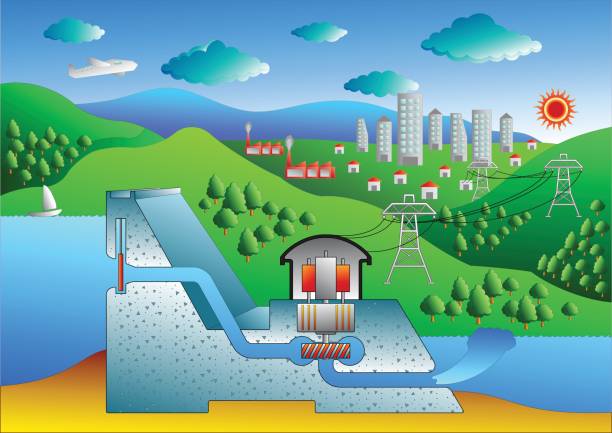
Renewable energy produced by flowing water, typically from dams or rivers, is known as hydropower. It uses generators and turbines to transform kinetic energy into electrical power. Although hydropower is clean, dependable, and helps with water supply, flood control, and irrigation, it may have an impact on ecosystems.
Here are 10 main uses of Hydropower:
- Electricity Generation – Produces renewable and clean electricity for households, industries, and businesses.
- Irrigation Support – Provides water supply for agricultural fields.
- Drinking Water Supply – Helps store and distribute fresh water for communities.
- Flood Control – Dams regulate river flow, reducing flood risks.
- Industrial Use – Supplies power for factories, mining, and production units.
- Navigation – Reservoirs and dams make rivers more suitable for transportation.
- Recreation & Tourism – Lakes, reservoirs, and dams are used for boating, fishing, and tourism.
- Aquatic Farming – Supports fish farming and other water-based livelihoods.
- Cooling for Power Plants – Provides water for cooling in thermal and nuclear plants.
- Environmental Benefits – Reduces dependence on fossil fuels, lowering greenhouse gas emissions.
Hydropower plants are made up of several important parts that work together to convert flowing water into electricity. Here are the main parts:
- Dam – Stores water in a reservoir and creates water pressure.
- Reservoir – The large water storage area behind the dam.
- Intake – A gate or passage that allows water to flow into the penstock.
- Penstock – A large pipe that carries high-pressure water from the reservoir to the turbines.
- Turbine – Rotating blades that spin when water flows through, converting water energy into mechanical energy.
- Generator – Connected to the turbine, it converts mechanical energy into electrical energy.
- Powerhouse – The building that contains turbines, generators, and other equipment.
- Control Gates / Valves – Used to regulate the flow of water.
- Transformer – Increases the voltage of electricity for long-distance transmission.
- Transmission Lines – Carry the electricity from the plant to homes, businesses, and industries.
- Starting a Hydropower Business requires careful planning, heavy investment, and compliance with government regulations. Here’s a point-to-point detailed guide for you:
Steps to Start a Hydropower Business
- Market & Feasibility Study
- Research local electricity demand.
- Study rivers, water sources, and terrain.
- Check government renewable energy policies and incentives.
- Site Selection
- Choose a location with a reliable water flow and elevation.
- Ensure land availability for the powerhouse, dam, and transmission lines.
- Conduct environmental impact assessments.
- Obtain Licenses & Permits
- Get approvals from government energy authorities.
- Secure water usage rights and environmental clearance.
- Apply for renewable energy subsidies and tax benefits.
- Project Planning & Design
- Hire hydro engineers and consultants.
- Design the dam, turbine system, and power transmission setup.
- Decide between small hydro, mini-hydro, or large hydro projects depending on budget.
- Financial Planning & Funding
- Estimate total project cost (land, dam, turbines, transmission).
- Approach banks, investors, or government grants.
- Create a long-term financial plan including operation & maintenance.
- Technology & Equipment Purchase
- Buy turbines, generators, control systems, and transmission infrastructure.
- Choose reliable suppliers for hydropower technology.
- Construction Phase
- Build dam/reservoir (if required).
- Install turbines, generators, and control systems.
- Set up transmission lines to connect with the grid.
- Testing & Commissioning
- Run trial operations to ensure safety and efficiency.
- Get certification from energy regulators.
- Power Purchase Agreements (PPA)
- Sign contracts with electricity boards or private buyers.
- Ensure stable income through long-term agreements.
- Operation & Maintenance
- Hire skilled staff for turbine operation and monitoring.
- Conduct regular inspections to prevent breakdowns.
- Keep safety and environmental standards in check.
- Expansion & Scaling
- Start small with mini/micro-hydro projects.
- Gradually expand to larger hydropower stations.
- Explore exporting power to nearby regions or industries.
📑 Hydropower Business Startup Documents
1. Business Plan
- Executive summary
- Business model (ownership, revenue generation, selling electricity to grid, etc.)
- Market analysis (energy demand, competitors, target market)
- Financial projections (capital investment, ROI, breakeven)
- Risk management
2. Technical Feasibility Study
- Hydrological survey (river flow, rainfall data)
- Geological survey (soil, rocks, seismic safety)
- Site assessment (location, water head, flow availability)
- Technology selection (turbines, generators, transmission system)
- Plant design and capacity report
3. Environmental & Social Impact Report
- Environmental Impact Assessment (EIA)
- Social Impact Assessment (SIA)
- Sustainability plan
- Rehabilitation & resettlement plan (if land is affected)
- Clearance from Ministry of Environment & Forest
4. Legal & Regulatory Documents
- Land lease / ownership agreement
- Water usage rights / river basin authority approval
- Power Purchase Agreement (PPA) with government / private buyers
- Electricity Regulatory Commission license
- Local government approvals
5. Financial & Investment Documents
- Capital requirement plan (land, dam, turbines, transmission)
- Funding sources (equity, bank loans, investors)
- Detailed cost estimation
- Subsidy / government grant application papers
- Insurance documents
6. Operational Documents
- Project implementation schedule (Gantt chart / timeline)
- Human resource plan (engineers, technicians, operators)
- Safety management plan
- Operation & Maintenance (O&M) manual
👉 Once these are ready, you can submit them to government agencies, banks, and investors to get funding and approvals.
- Hydropower business can be profitable, but it also faces some serious challenges. Here are the main problems that can arise:
- High Initial Cost – Building dams, turbines, and infrastructure requires huge investment.
- Long Approval Process – Government clearances, land acquisition, and environmental approvals take years.
- Environmental Issues – Dams can affect fish, forests, river flow, and local biodiversity.
- Displacement of People – Villages or communities near dam sites may need relocation.
- Seasonal Dependence – Hydropower depends on rainfall and river water levels, which can be uncertain.
- Natural Disasters – Floods, landslides, and earthquakes can damage hydropower projects.
- Maintenance Cost – Regular repair of turbines, dams, and transmission lines is expensive.
- Conflict with Farmers/Locals – Water usage rights may create disputes.
- Climate Change Impact – Changing rainfall patterns can reduce power generation.
- Regulatory Risks – Policy changes, taxation, or new environmental laws can affect profits.
Happiness from doing a hydropower business depends on both personal satisfaction and business outcomes. Let’s look at it in two angles:
1. Personal Happiness Factors
- ✅ You’ll feel proud of working in clean energy, which helps the environment.
- ✅ It can give you satisfaction that you’re creating long-term impact (reducing carbon footprint, providing electricity).
- ✅ Hydropower projects are usually long-lasting, so you’ll feel secure in building something permanent.
- ❌ On the other hand, it requires big investment, government permissions, and patience. If you dislike waiting or dealing with regulations, stress may reduce happiness.
2. Business Happiness Factors
- 💰 If the project is successful, you’ll get steady income for years since hydropower gives constant electricity supply.
- 🏆 Recognition in society for being in the renewable energy sector.
- ⚠️ But if the project faces delays, high costs, or land/water issues, it may cause frustration.
👉 So, happiness level = High if you love long-term, impactful work + can handle challenges.
👉 Happiness level = Low/Stressful if you expect quick profit or an easy process.
Leave a Reply