

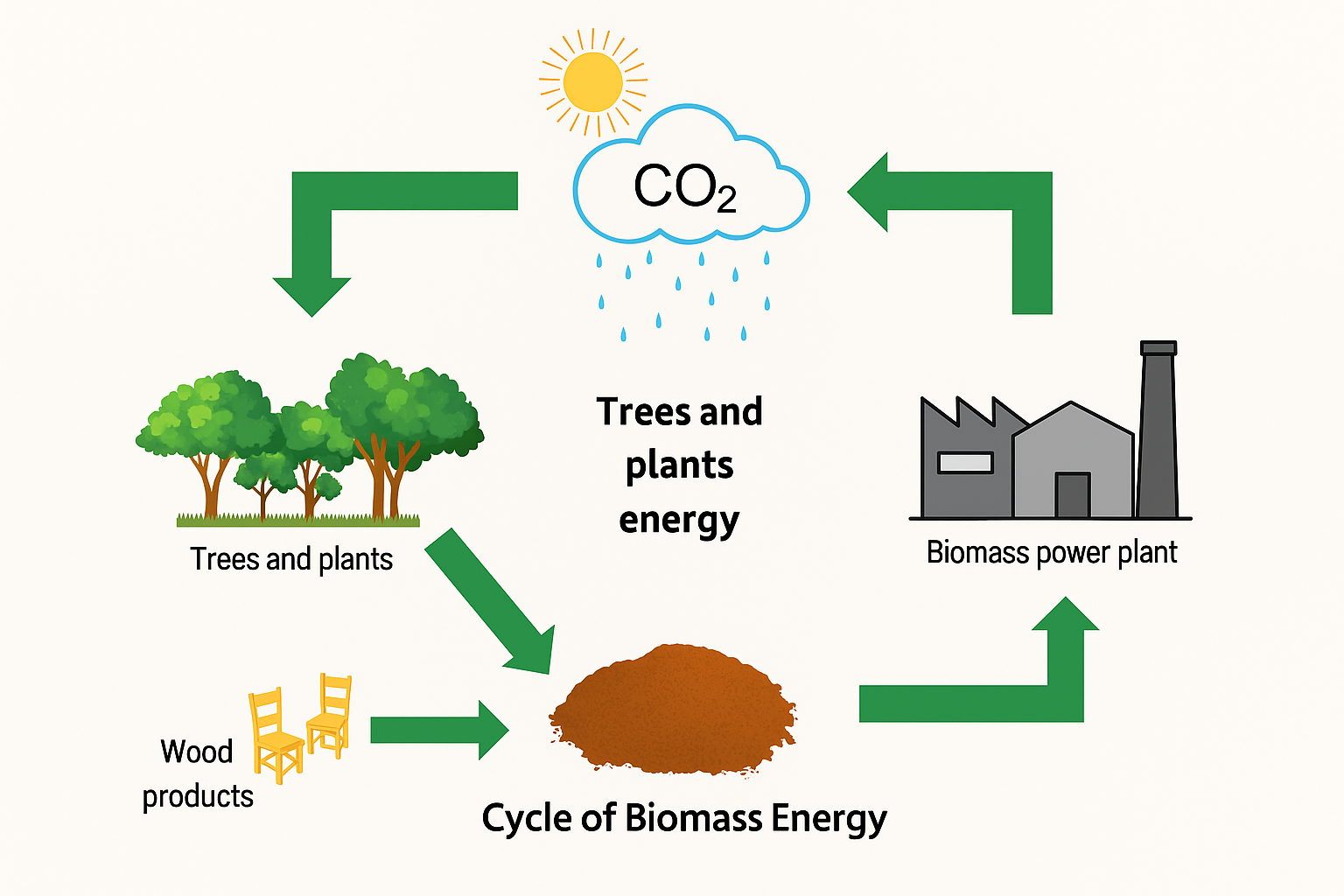
Renewable energy derived from organic materials such as plants, crops, wood, and agricultural waste is known as biomass energy. It can be transformed into heat, power, or biofuels, which lowers carbon emissions, lessens landfill waste, and encourages the use of sustainable energy sources.
Here are 10 uses of Biomass Energy:
- Electricity Generation – Biomass can be burned to produce steam that drives turbines for electricity.
- Heat Production – Used for heating homes, industries, and water.
- Biofuels – Conversion into bioethanol, biodiesel, or biogas for vehicles.
- Cooking Fuel – Biomass like wood, pellets, or agricultural waste used for cooking in rural areas.
- Industrial Energy – Powers boilers, furnaces, and other industrial equipment.
- Waste Management – Converts agricultural and organic waste into energy, reducing landfill usage.
- Chemical Production – Raw material for biochemicals like methanol, ethanol, and acetone.
- Combined Heat & Power (CHP) – Simultaneously generates heat and electricity efficiently.
- Fertilizer Production – Residues from biomass energy production can be used as organic fertilizer.
- Rural Development – Provides local employment and energy independence in rural areas.
- Biomass energy is derived from organic materials, and it contains several key components that contribute to energy production. The main parts are:
- Feedstock (Raw Material) – Organic matter used to produce energy, e.g., wood, crop residues, animal manure, food waste.
- Moisture Content – Water present in the biomass; affects energy efficiency.
- Cellulose – A carbohydrate polymer forming plant cell walls; primary source of combustible material.
- Hemicellulose – Another carbohydrate polymer; easier to break down than cellulose.
- Lignin – Complex organic polymer that gives plants rigidity; releases energy when burned.
- Extractives – Waxes, resins, and oils in biomass that can be converted into biofuels.
- Ash – Non-combustible mineral content remaining after burning; can affect boiler performance.
Here’s a point-to-point detailed guide on starting a Biomass Energy Business:
1. Understand Biomass Energy
- Biomass energy is generated from organic materials like agricultural waste, wood chips, animal waste, and crops.
- It can produce electricity, heat, or biofuels.
- Research local demand for renewable energy.
2. Market Research
- Identify areas with high agricultural or forest waste availability.
- Analyze local energy needs (industries, households, or government).
- Study competitors and their pricing, products, and technology.
3. Choose Business Model
- Options include:
- Biogas Plant (methane from animal/food waste)
- Pellet Manufacturing (fuel pellets from wood/agri-waste)
- Biofuel Production (biodiesel from crops/waste oil)
- Biomass Power Plant (electricity generation)
4. Legal Formalities
- Register the business under private limited, LLP, or proprietorship.
- Obtain environmental clearance and pollution control permits.
- Apply for government incentives or subsidies for renewable energy.
5. Location & Infrastructure
- Near raw material source (farms, forests, industrial waste).
- Enough space for storage, processing, and machinery.
- Ensure electricity, water, and transport access.
6. Technology & Equipment
- Choose the technology based on your model:
- Biogas digester
- Biomass gasifier
- Pelletizer and dryer
- Biofuel reactors
- Partner with reliable suppliers for machinery.
7. Raw Material Procurement
- Source agricultural residues, wood, or industrial organic waste.
- Ensure steady supply contracts with farmers, industries, or municipalities.
8. Production & Operation
- Train staff for safety and efficient operations.
- Follow quality standards for fuel/pellets/biogas.
- Monitor energy output and waste management.
9. Marketing & Sales
- Target industries needing renewable energy.
- Offer eco-friendly fuel for households.
- Promote government incentives for green energy users.
10. Financial Planning
- Initial investment depends on scale:
- Small biogas plant: ₹5–10 lakh
- Medium biomass plant: ₹50 lakh–₹1 crore
- Large biomass power plant: ₹5–10 crore
- Plan ROI, operational costs, and raw material costs.
11. Government Support & Incentives
- Check schemes like MNRE (India) for renewable energy projects.
- Subsidies can cover capital costs or interest on loans.
12. Environmental & Social Impact
- Reduces waste and pollution.
- Provides employment opportunities in rural areas.
- Must follow sustainable harvesting and waste management practices.
Here’s a point-to-point detailed guide on starting a Biomass Energy Business:
1. Understand Biomass Energy
- Biomass energy is generated from organic materials like agricultural waste, wood chips, animal waste, and crops.
- It can produce electricity, heat, or biofuels.
- Research local demand for renewable energy.
2. Market Research
- Identify areas with high agricultural or forest waste availability.
- Analyze local energy needs (industries, households, or government).
- Study competitors and their pricing, products, and technology.
3. Choose Business Model
- Options include:
- Biogas Plant (methane from animal/food waste)
- Pellet Manufacturing (fuel pellets from wood/agri-waste)
- Biofuel Production (biodiesel from crops/waste oil)
- Biomass Power Plant (electricity generation)
4. Legal Formalities
- Register the business under private limited, LLP, or proprietorship.
- Obtain environmental clearance and pollution control permits.
- Apply for government incentives or subsidies for renewable energy.
5. Location & Infrastructure
- Near raw material source (farms, forests, industrial waste).
- Enough space for storage, processing, and machinery.
- Ensure electricity, water, and transport access.
6. Technology & Equipment
- Choose the technology based on your model:
- Biogas digester
- Biomass gasifier
- Pelletizer and dryer
- Biofuel reactors
- Partner with reliable suppliers for machinery.
7. Raw Material Procurement
- Source agricultural residues, wood, or industrial organic waste.
- Ensure steady supply contracts with farmers, industries, or municipalities.
8. Production & Operation
- Train staff for safety and efficient operations.
- Follow quality standards for fuel/pellets/biogas.
- Monitor energy output and waste management.
9. Marketing & Sales
- Target industries needing renewable energy.
- Offer eco-friendly fuel for households.
- Promote government incentives for green energy users.
10. Financial Planning
- Initial investment depends on scale:
- Small biogas plant: ₹5–10 lakh
- Medium biomass plant: ₹50 lakh–₹1 crore
- Large biomass power plant: ₹5–10 crore
- Plan ROI, operational costs, and raw material costs.
11. Government Support & Incentives
- Check schemes like MNRE (India) for renewable energy projects.
- Subsidies can cover capital costs or interest on loans.
12. Environmental & Social Impact
- Reduces waste and pollution.
- Provides employment opportunities in rural areas.
- Must follow sustainable harvesting and waste management practices.
Biomass Energy Business Startup Document
1. Executive Summary
- Business Name: [Your Business Name]
- Business Type: Renewable Energy – Biomass Energy Production
- Location: [City/State/Country]
- Mission: To generate sustainable energy from organic waste, agricultural residue, and plant biomass while reducing environmental pollution.
- Vision: To become a leading supplier of renewable biomass energy solutions, promoting sustainable energy practices in [Your Region].
- Objective: Set up a biomass energy plant with [X] MW capacity to supply electricity/fuel to industrial and domestic users.
2. Business Overview
- Industry: Renewable Energy / Green Energy
- Type of Business: Manufacturing & Energy Production
- Products/Services:
- Bioelectricity generation
- Biomass briquettes and pellets
- Biogas for cooking/fuel
- Organic fertilizers (by-product)
- Target Market:
- Local industries needing electricity/fuel
- Households and commercial kitchens
- Government energy projects
- Agricultural sector
3. Market Analysis
- Current Scenario:
- Renewable energy is growing due to environmental concerns.
- Government incentives for biomass energy are available in India.
- Demand:
- Increasing demand for green energy and waste-to-energy solutions.
- Competitors:
- Local biomass plants, solar energy companies, and biogas suppliers.
- Opportunities:
- Tie-ups with agricultural cooperatives for raw material supply.
- Participation in government renewable energy programs.
4. Business Model
- Revenue Streams:
- Sale of electricity to the grid or industries
- Sale of biomass briquettes/pellets to households and industries
- Sale of biogas for domestic/commercial use
- Sale of organic fertilizer by-product
- Cost Structure:
- Land & facility setup
- Machinery & equipment
- Raw material procurement
- Labor & operational costs
- Maintenance and logistics
5. Technical Plan
- Raw Materials: Agricultural residues, forest waste, animal waste, industrial organic waste
- Technology Required:
- Biomass gasifiers
- Pellet machines
- Boilers for bioenergy
- Biogas digesters
- Energy Output Capacity: [Specify MW or units per day]
- Production Process:
- Collection of biomass
- Drying and processing
- Conversion to electricity, briquettes, or biogas
- Distribution
6. Legal & Regulatory Compliance
- Licenses Needed:
- Renewable Energy Certificate (REC)
- Environmental clearance from local authorities
- Pollution control board approval
- Company registration and GST compliance
- Government Incentives:
- Subsidies on biomass plant setup
- Tax incentives for renewable energy production
7. Financial Plan
- Startup Investment:
- Land & infrastructure: ₹ [Amount]
- Machinery & technology: ₹ [Amount]
- Initial working capital: ₹ [Amount]
- Licensing & registration: ₹ [Amount]
- Revenue Projection (Year 1-3):
- Year 1: ₹ [Amount]
- Year 2: ₹ [Amount]
- Year 3: ₹ [Amount]
- Break-even Analysis: Expected in [X] years
8. Marketing & Sales Strategy
- Marketing Channels:
- Direct sales to industries
- Government energy tenders
- Online marketing for briquettes/biogas
- Partnership with agricultural societies
- Unique Selling Proposition (USP): Eco-friendly energy solutions, cost-effective fuel, renewable energy compliance.
9. Risk Analysis
- Potential Risks:
- Fluctuating raw material supply
- High initial investment costs
- Technological failure or maintenance issues
- Government policy changes
- Mitigation Measures:
- Long-term supply agreements with farmers
- Proper equipment maintenance and staff training
- Continuous monitoring of government policies
10. Team & Management
- Founder/CEO: [Name]
- Technical Expert: Responsible for plant operations
- Marketing & Sales Manager: Handles customer acquisition
- Finance Manager: Oversees accounting, funding, and revenue
- Support Staff: Operations, logistics, and administration
11. Implementation Timeline
| Phase | Activity | Timeline |
|---|---|---|
| Phase 1 | Land & permits | Month 1-3 |
| Phase 2 | Machinery installation | Month 4-6 |
| Phase 3 | Hiring & training | Month 5-6 |
| Phase 4 | Pilot production | Month 7 |
| Phase 5 | Full-scale operations | Month 8 onwards |
12. Sustainability & Social Impact
- Reduce landfill waste by using organic material
- Provide employment opportunities locally
- Promote clean energy and reduce carbon footprint
- Starting a biomass energy business can be promising, but like any energy or industrial business, it comes with several potential challenges and problems. Here’s a detailed breakdown:
1. Raw Material Supply Issues
- Biomass depends on organic materials like agricultural waste, wood, or dedicated energy crops.
- Problems:
- Seasonal availability (harvest times vary).
- Competition with other uses (fodder, compost).
- Logistics and storage challenges (biomass can rot if stored improperly).
2. High Initial Investment
- Setting up a biomass plant requires investment in:
- Biomass boilers or gasifiers
- Storage facilities
- Transportation vehicles
- Problem: Small-scale entrepreneurs may struggle with funding.
3. Technology and Efficiency Challenges
- Converting biomass into energy efficiently is complex.
- Problems:
- Low energy conversion efficiency if outdated or improper technology is used.
- Maintenance of machinery is costly.
- Skilled operators are needed.
4. Environmental and Regulatory Issues
- Biomass combustion can produce smoke, ash, or pollutants if not managed properly.
- Problems:
- Requires compliance with environmental laws.
- Permits for waste collection and emissions may take time.
- Local community opposition due to odor or pollution concerns.
5. Market and Price Fluctuations
- Selling energy or biomass fuel depends on local demand.
- Problems:
- Electricity prices or feedstock prices may fluctuate.
- Dependence on government incentives or subsidies can be risky.
6. Transportation & Logistics Problems
- Collecting and moving bulky biomass material is a challenge.
- Problems:
- High transportation costs reduce profitability.
- Supply chain disruptions can halt production.
7. Competition and Alternative Energy
- Competes with solar, wind, and fossil fuels.
- Problems:
- If other renewable sources become cheaper, biomass may lose demand.
In short: The main issues are raw material supply, high costs, technical challenges, environmental compliance, and market risks. Proper planning, partnerships with farmers, and technology investment can reduce these risks.
Sources of Happiness You Might Get:
- Purposeful Impact – You’re helping the environment by reducing waste and promoting renewable energy. This gives a strong sense of contribution to society and sustainability.
- Innovation Joy – Working in renewable energy often involves problem-solving, new tech, and learning, which can be intellectually rewarding.
- Financial Satisfaction – If managed well, biomass energy can be profitable. Financial stability brings peace of mind and reduces stress.
- Community Respect – Being part of a green initiative can earn respect in your community or industry.
- Pride in Achievement – Building a business from scratch and seeing it work can boost confidence and self-esteem.
Potential Challenges That Affect Happiness:
- High initial investment and long payback periods.
- Technical challenges in sourcing, processing, or maintaining biomass systems.
- Regulatory hurdles or government approvals.
Bottom line: Your happiness is likely to come from purpose + learning + achievement, but it depends on how much you enjoy problem-solving, working sustainably, and managing a business. If environmental impact excites you, the happiness factor could be quite high.
Leave a Reply